Solar panels installed on a residential rooftop
Singapore 2026

Solar Panel Installation
Across Singapore

A factual reference covering HDB SolarNova deployment, landed-home photovoltaic systems, EMA regulatory requirements, and return-on-investment data for residential solar in the city-state.

Solar Adoption in Singapore: Where Things Stand

Singapore receives an annual average solar irradiance of approximately 1,580 kWh/m² — among the highest in Southeast Asia. Despite limited land area (733.1 km²), the country has deployed over 1.1 GWp of solar capacity as of Q1 2026, up from just 33.1 MWp in 2015.

The government has set a national target of 2 GWp by 2030, later raised to 3 GWp under Budget 2026. Much of this growth comes from rooftop installations on HDB blocks through the SolarNova programme and a steady increase in private residential adoption on landed properties.

This reference compiles verified data on installation processes, costs, regulatory approvals, equipment specifications, and financial projections drawn from official sources including HDB, EMA, and BCA publications.

Singapore Central Business District skyline
3 GWp National solar target by 2030
455 MWp Committed across HDB estates
4–7 yr Typical residential payback period
25+ yr Expected panel lifespan

Key Topics Covered

HDB residential blocks in Singapore
HDB

SolarNova Programme & HDB Rooftop Solar

An overview of the multi-phase SolarNova deployment: 455 MWp committed across thousands of HDB blocks, the tendering process with Sunseap, net-zero common area consumption, and the regeneration pilot that extends panel life by 4–5 years.

Solar panel installation on a residential roof
Landed

Solar for Landed Properties in Singapore

Practical data on installing photovoltaic systems on semi-detached houses, bungalows, and terrace homes. Covers system sizing (5–15 kWp), monocrystalline vs. polycrystalline panels, inverter selection, and the BCA/URA approval timeline.

Smart electricity meter
Finance

ROI Calculations & Long-Term Savings

Detailed financial modelling for residential solar: upfront costs (SGD 12,000–25,000), annual savings of SGD 3,500–4,500, 25-year net returns exceeding SGD 80,000, and the impact of SP Group tariff changes on payback timelines.

EMA Regulatory Framework

The Energy Market Authority (EMA) oversees all electricity generation in Singapore, including rooftop solar. Residential systems below 1 MWac are categorised as "Market Participant" generators and must register with SP Group for net metering or the Simplified Credit Treatment (SCT) scheme.

Under the Enhanced Central Intermediary Scheme (ECIS), homeowners with systems up to 10 kWp can sell excess electricity back to the grid at the prevailing low-tension tariff. Registration is free and handled through SP Group's portal. Systems above 10 kWp require a generation licence from EMA.

All installations must comply with SS 555 (Code of Practice for Protection Against Lightning), CP 5 (Electrical Installations), and the Building Control Act for structural loading. Licensed electrical workers (LEWs) must oversee the connection.

Source: Energy Market Authority

Choosing the Right Panel Type

Three photovoltaic technologies dominate the Singapore residential market as of 2026:

  • Monocrystalline (Mono-PERC) — 20–25% efficiency, 25–40 year lifespan, SGD 1.30–1.80 per Wp. The most widely installed type for landed homes due to highest output per square metre.
  • Polycrystalline — 15–18% efficiency, 20–30 year lifespan, SGD 0.90–1.20 per Wp. Lower cost but requires more roof space, suitable for larger rooftops.
  • Thin-Film (CdTe/CIGS) — 10–13% efficiency, 15–25 year lifespan, lighter weight. Used mainly in specialised commercial and BIPV applications rather than standard residential.

Performance degradation in Singapore's tropical climate averages 0.5–0.8% per year for monocrystalline panels, according to data from the Solar Energy Research Institute of Singapore (SERIS).

Source: SERIS — National University of Singapore

Technicians installing solar panels on a roof

Installation Process Overview

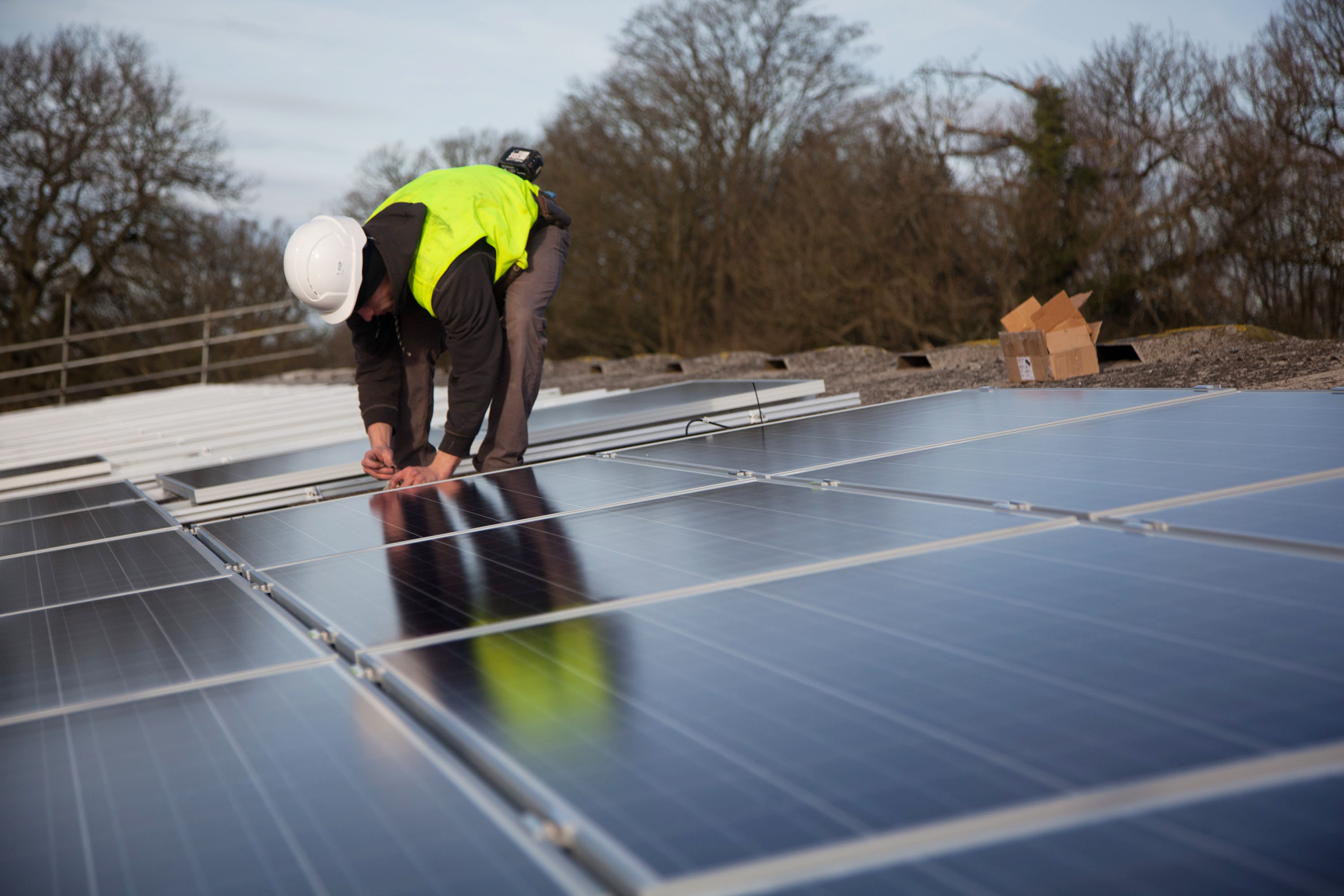
A typical residential solar installation in Singapore follows a sequence of assessment, design, regulatory approval, physical installation, and grid connection. For HDB blocks, SolarNova contractors handle the entire lifecycle. For landed homes, the process takes 6–12 weeks from initial site survey to Turn-On (TO) approval from SP Group.

Key milestones include structural assessment (PE-certified), electrical design submission, BCA/URA clearance, equipment procurement, roof-mounting, inverter installation, final testing, and meter reconfiguration.

Read Full Installation Timeline

Referenced Data Points

540 MWp

HDB SolarNova target by 2030 for public housing rooftops across Singapore.

SGD 18,000–25,000

Typical cost range for a 10 kWp residential system on a landed property in 2026.

0.5–0.8%

Annual performance degradation rate for monocrystalline panels in tropical conditions (SERIS data).

6–12 Weeks

Typical timeline from site survey to grid-connected, operational solar system on landed homes.